





What Is Triton Tempo? Inside Triton Poker’s New Chess-Clock Timing System

pessi-lamm
21 Mar 2026
Pessi Lamm 21 Mar 2026
Share this article
Or copy link
  • Triton Tempo uses a chess-clock style timing, replacing traditional shot clocks.
  • Players have a single tournament-long time bank, spent by the second.
  • System visibility adds drama for fans and curbs stalling by players.
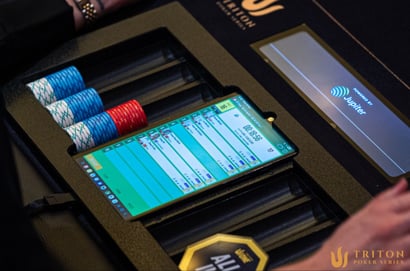
Triton Tempo interface
Triton Tempo dealers interface in action. (credit: tritonpokerseries.com)
Triton Tempo is a new, fully networked chess-clock style timing system debuted at the Triton Poker stop in Jeju, designed to replace traditional shot clocks with a more flexible and transparent way to manage thinking time.

Instead of burning 30-second time-bank cards for every tough spot, players get a single personal time bank for the whole tournament and spend it second by second whenever they need extra time.

Through 10 years on the Triton Poker Series, we have collated an enormous amount of data relating to all aspects of poker tournament play. After analysing this data, and discussing the issue with players, floor supervisors and dealers, we have been able to determine what we think is a fair amount of time to make most decisions. As with everything at Triton, we listen to feedback from all relevant parties and can make adjustments as necessary. -Triton Poker

How the Base Clock Works

Triton Tempo still uses a standard countdown per decision, similar to a shot clock, but with structured base times by street.
Typical base times look like this:​
  • Preflop: around 15 seconds (20 seconds in PLO)
  • Flop: 25 seconds
  • Turn and river: 30 seconds
If a player acts within that base window, their time bank is untouched; only when they go over does the personal bank start ticking down.

Triton Tempo: Personal Time Bank For Each Tournament

The key innovation is that each player has one tournament-long time bank instead of multiple chunky 30‑second extensions.

Extra time is deducted in single seconds, not full 30‑second blocks. Players who register early receive a larger starting time bank, rewarding those who are in their seats from the start.

Additional time is added later in the tournament so players still have breathing room deep in the money.
That allows someone to use just five extra seconds on a marginal decision instead of “wasting” an entire 30‑second chip.

Each Timer Visible For All Players and Fans

Triton Tempo is fully networked, so timing information is visible at the table and through Triton’s digital channels.

When action is on a player, their name, seat, and remaining time are clearly displayed.​

The Triton Plus app lets viewers see each player’s remaining time bank in real time, highlighting who is under pressure and who still has time to burn.

This visibility makes stalling much harder and adds a new layer of drama for the audience.

Why Pros Are Calling It a “Game Changer”

Top pros like Daniel Negreanu and Phil Hellmuth have publicly praised Triton Tempo as a fairer upgrade over standard shot clocks.

Negreanu called it an “innovative game changer” and argued that chess-clock style timing is more equitable than fixed 30‑second extensions.

Hellmuth noted that the system still lets players take several minutes when a spot truly deserves it, but prevents chronic tanking from slowing the whole table.

By rewarding efficient decisions and punishing constant tanking, Triton Tempo aims to speed up the game without forcing snap decisions in massive pots.
Here's how Triton Tempo works in practice explained by Triton:

Triton Tempo FAQs

Do players get more time bank as they go deeper in the tournament?

Yes. Triton Tempo adds extra seconds at key stages, including after registration closes and again at the final table, with smaller boosts in turbos and satellites and custom allocations for some longer events.

Why do late registrants get less time bank?

Late entrants have fewer hands and fewer decisions to play, so they receive less total clock time. The structure also encourages players to arrive on time and helps tournaments run more smoothly from the start.

Who controls the Triton Tempo clock?

The dealer operates the Triton Tempo interface at the table. Dealers are trained to move the active clock from player to player as the action progresses.​

What happens to the clock if a player changes tables?

A player’s remaining time moves with them. Triton’s tracking system updates seat changes in real time, so the time bank stays attached to the player rather than the table.

How long does a player have before the time bank starts running?

Triton Tempo first gives players a base decision window: 15 seconds preflop in NLH, 20 in PLO, 25 on the flop, and 30 on the turn and river. Only after that does the system start deducting from the player’s time bank.

What if the wrong player’s clock is running?

That kind of mistake is expected to be very rare, but tournament staff can manually adjust the time bank if needed. The system is designed to allow corrections in exceptional cases.​

What happens when a player’s time bank reaches zero?

A player does not lose all future hands once their time bank is gone. They still receive the normal base decision time on each action, and a hand is only dead when both the base time and any available extra time for that decision have fully expired; otherwise, it becomes an automatic check if no bet is facing them.


Upcoming Events

12 July 2026

CoinPoker $7 Million July Promotion Poker CoinPoker Expands CoinRewards to More Than $7 Million Per Month